
Studio Tour November 2019
Hello Friends!
As 2019 comes to a close, I want to share a video of what’s been happening in my studio recently. I like to do this from time to time because I think it’s helpful to see what other artists are up to in their practice.
I also think it’s helpful to take a moment to pause and take stock of everything that has happened in a year. You may be surprised about how all of those little moments of art making even in 15 minutes increments of studio time here and there can really add up!
As we begin to turn into a new year, I encourage you to take some time to reflect on your studio journey this year. What went well? What did you struggle with? What new things did you learn? And what does taking stock of the past bring up for you? Does it inspire something for the coming year?
I invite you to share your reflections with everyone in the comments section below. Community is one of the most important things we build as artists and is what helps us through the tough or slow times. I love hearing from you on how this forum adds to your practice and how I can continue to support you.
And if you are looking for more studio tips and guidance over the winter break, head on over to my Youtube channel. We have quite the community growing there, too!
All my best,
Michele
Leave a Comment
Is your work important? Does it matter? Why bother?
I strongly recommend that every artist I mentor have a website or at least blog to share his or her work with the world. One of the artists I worked with once asked me:
“Who in the world needs another blog from a half-hearted artist?”
Who, indeed?
Who are we to say what the world needs or doesn’t need? It’s important to be able to step back from that voice and to recognize it for what it is. It’s the voice of our ego. Our ego prefers to be liked, to stay safe and protect us from criticism or negative reaction.
I want to remind you of your power as an artist. The power art has in general. Whether our audience is large or small, we all have the potential to positively impact others lives with what we do.
While the ego likes to stay safe it is also attracted to the seeming glamour of celebrity and fame. It’s a strange dichotomy, isn’t it?
So unless we are really, really big, unless lots and lots of people like and admire our work, it doesn’t seem worthwhile.
Take a moment now to recall anyone who has expressed even the smallest appreciation for something you have created. A brief compliment, an email, a note, a thumbs up.
Now savor that moment slowly for what it was. Really feel into it and allow it into your being, your body, your heart.
You touched another person’s heart, even for that moment, in some humble way.
Where there was one, there could easily be hundreds. (It’s a big planet, you know.)
It is tempting to keep things safe and play a small and familiar arena. It’s tempting to avoid the risk and vulnerability of putting ourselves and our work out for the world to see. It is so much easier. We need not take the time nor make the effort.
But how do you know that someone wouldn’t be inspired by, love, or really want to see your blog? How do you really know this?
Aren’t there plenty of other artists who have inspired you? Are you glad for their online presence? Isn’t it wonderful to live in an age where we can access inspiration from other artists’ work past or present with the click of a mouse?
Who are your favorite artists of all time? How would your life be different if your favorite artists had never pursued their work and committed to getting it out to the public?
What it takes is commitment. I think the key word in this artist’s question was “half-hearted”. I know the asker of this question to be a truly dedicated and committed artist with wonderful gifts to share.
However, if we go about creating a website or instagram only half-heartedly, then most likely neither we nor our potential viewers will gain satisfaction from it. Beyond the content, the energy behind the content will be lackluster.
However, if we commit ourselves to it, even if we can only post once a month and we do our best to get the word out and share it with the world, I am convinced that we can touch others in a meaningful way. People will be drawn to our enthusiasm and what we have to offer.
When we do things without true commitment they lack that power of our own intention. If things don’t work out how we expected, we have no reason to continue or follow-through.
The ego likes this because we stay in our safe zone. We don’t expose ourselves to criticism or perhaps worse for the ego, neglect.
When we are committed, we will do whatever it takes.
I invite you to share a moment where you persisted, or how you overcome the urge to give up in the comments below. Your story makes this a community and can help others.
Leave a Comment
5 Tips For Saving Money on Art Supplies
Recently, someone was watching one of my videos and commented on how much paint I was using to demonstrate. Many beginning painters and even more experienced painters on a tight budget can be very hesitant about using materials for fear of wasting them. I can SO relate to this feeling! If you’re one of these “Frugal Frannies” as I was, this video is for you.
Most of us can benefit from finding ways to save money, so I have some of my top tips. PLEASE share yours in the comments below.
1. Surfaces
The most common surface material for painting is stretched canvas. Buying the pre-stretched canvases is your most expensive option. Here are some alternatives:
- Canvas board: Canvas boards are canvas stretched over cardboard and come primed with gesso and ready to.
- Cardboard, heavy Bristol board or chipboard. Before painting, I would suggest prepping the surface with gesso.
- Wood: You can often get pieces of wood inexpensively at a lumberyard in their scrap bin. If you want to buy larger quantities, try Masonite or MDF board and have the large sheets cut to your preferred size on site.
- Heavy weight rag paper: Available at art supply stores. You may need to ask a sales associate to show you which papers are 100% rag. You will want to prep the surface with gesso before painting on paper.
2. Paint
There are many grades or quality levels of paints. Student grade paints are more economical but not all are created equal. If you are interested in learning more, you can watch my video on the 4 Different Types of Acrylic Paint. Two student grade paint brands I can suggest are:
- Liquitex Basics – get a lot of paint for your money with good pigment load.
- Windsor Newton Galeria – has a good pigment density
A quick note on housepaint because I often get asked about it – it’s not meant to last a long time and has less pigment but is ok for learning and practice.
3. Brushes
I have another video where I discuss different types of brushes. I strongly believe that if there is anything you are going to spend good money on, invest in good brushes. Poor brush quality can make paint hard to control.
4. Palettes
A lot of times beginners and students use disposable palettes. I don’t prefer these because of the impact on the environment and the fact that they actually get expensive because you keep having to replace the pad once you run out.
Another disposable material you can use is freezer paper that is found at most grocery stores. It’s the same material as the disposable palettes, but it’s a lot cheaper.
I prefer the butcher tray palette. It’s a metal tray covered in enamel. You can easily cover it and keep paints wet for future painting sessions. Please watch this video for more details.
5. Bargain shopping
Art supply stores often have “Back to School” sales. Look for these at the beginning of the school semester. Many stores also have coupons or coupon apps.
You might also try Ebay. In a quick search I was surprised how many acrylic paints came up. Just make sure that if you are purchasing from someone online that they have good reviews and accept returns. Garage sales and estate sales, thrift stores and reuse stores may also yield new or gently used art supplies.
Here are some resources for artists in the SF Bay Area:
Scrap 801 Toland St, San Francisco, California 94124 (enter on Newcomb)
East Bay Depot for Creative Re-Use 4695 Telegraph Ave. Oakland California USA
FabMo Designer fabric and samples for creative re-use 970 Terra Bella Avenue, Suite 5 Mountain View, CA 94043
I’d love to know: How do you save money on supplies? Please share your tips in the comments below!
Leave a Comment
Feeling unsure or insecure about your work?
I was recently an artist-in-residence in Northern California where I had the chance to learn letterpress along with other printmaking techniques. All the processes I learned were brand new to me and I enjoyed the challenge of incorporating them into my oeuvre. After twelve intense days of printmaking, the residency culminated in a public exhibition. Because it was such a quick turnaround, I hadn’t really had time to fully resolve one of my pieces and get it to a place where I felt complete. I decided to show it anyway.
Because I wasn’t sure how I felt about it, I started to worry about what other people would think about it and how well it would be received. These were uncomfortable feelings that I hadn’t experienced in a while.
But after taking some time to reflect, I realized that it is important to me that my studio practice continues to grow and change. Staying stagnant or doing the same thing over and over again doesn’t feel energizing to me. There will be times when I make things that I don’t like.
As artists, it’s important for us all to remember that we need to be ok with being uncomfortable. This is what leads to new discoveries or solutions. Sometimes the hardest part of being in the studio is setting our ego aside. You can’t predict how someone will feel about your work and at the end of the day, that isn’t your job. Your job is simply to create.
I invite you to join the conversation. How do you handle feelings of insecurity when they crop up? Share with me and the mindful artist community in the comments below.
Leave a Comment
The Importance of Creating Community
Making art is by nature an isolating activity. The majority of artists work alone and need quiet time in the studio to focus and concentrate, to allow ideas to bubble up, to experiment freely without prying or inquiring eyes. When I go to my studio, I like to close the door, turn off the phone, shut out the world and enter a deep, almost meditative state of concentration.
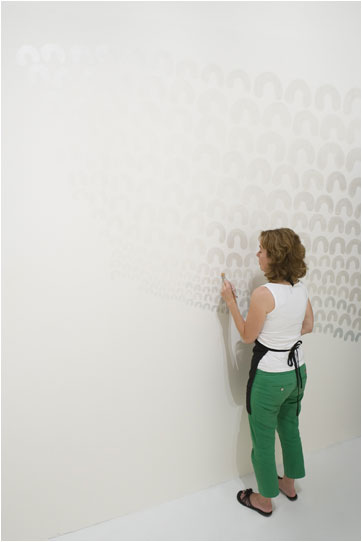 Although the creative work itself may necessitate alone time and privacy, the life of an artist needn’t be lived in isolation. In fact, our success depends on the connections we cultivate. I’m not simply referring to “meeting the right people” – the influential ones who can give us something, or move our work forward. My daily life is made full by my rich community of artist friends.Which means I spend many hours of my day completely alone.
Wherever you go or decide to live, cultivating a community of like-minded individuals will nourish your work. Unlike others, your artist friends will not be insulted when you choose to go to your studio on a Friday night instead of joining them at the movies.
When you are going through of periods of scant or no recognition, having no shows on the horizon, no grants to sustain you, no gallery to promote you, who will remind you how much it matters to keep doing the work?
I am fortunate to be married to a musician with a very down-to–earth philosophy on being an artist. If ever I begin to feel down-and-out, sorry for myself, or under-appreciated, he looks me in they eye and says “You are doing it for yourself, right?” and then I feel more on track. While I am not exactly doing it for myself (I sincerely want other people to benefit from my work), he reminds me that I am not in it for fame or acclaim.
Who will understand why you are devoting a large portion of your income to studio rent? Or to some ambitious five-year project? Lots of people will not relate to your lifestyle, nor will they understand it.
When the outside world seems indifferent to your creative output, your artist friends will remind you to keep at it. They won’t necessarily do this by saying so, but you will observe them making their own work, devoting their time and energy to it, and this will buoy you onward.
I invite you to share your thoughts with me in the comments below. How do you build your community as an artist? Who are the people that support your practice?
Leave a Comment
Keeping an Open Heart in the Face of Disappointments
Part of being an artist is riding the natural ups and the down cycles. There will be high times (we are getting published, in shows, having sales, or accolades) and inevitable lower times (we didn’t accepted into a show or get the grant, or residency or what have you).
A while back, I watched a documentary called “How To Cook Your Life”, a film about Edward Espe Brown, a zen priest who was the head tenzo, or cook, at the Zen Buddhist retreat, Tassahara.
There were many pearls in this film, but one that struck me was when he spoke of life’s disappointments. I will paraphrase, but basically he said, that we hold in our hearts our dearest, most precious wishes for ourselves – for our happiness.
And then in life, we encounter inevitable heartbreaks and pain. When things don’t turn out the way we want we try to control or defend ourselves from the disappointment we feel.
So we begin to separate ourselves from our heart’s desires. And in doing so, we actually separate ourselves from our heart.
And while we may succeed in insulating ourselves from future disappointments, we create a much deeper chasm. We begin to feel an ache inside; a longing. And no matter how many material trophies we acquire it doesn’t go away. Because we have separated from our heart.
We all guard our hearts so zealously. We are so careful about whom we open them to. We are so afraid of breaking them.
This is an exercise in futility. In this life, the heart will break.
It will break open and grow bigger.
It will break like the sunrise. It will break like a wave. It will not be destroyed.
What destroys us is keeping our hearts locked up in armor of fear. This fear of being open and vulnerable doesn’t allow our hearts to grow.
The irony is this. We are not meant to protect out hearts. Our hearts are meant to protect us. When the heart is open and loving it is free of fear.
There is no stronger “protection” than a fearless heart.

Yearn (detail) © 2004 watercolor, acrylic, gouache on panel
Leave a Comment


